

Blog · Nov 14, 2026 · SeraVerra Research · 2 min read
Their robots.txt says welcome. Their server says no.
1,301 sites refuse at least one crawler their own robots.txt allows — beside just 194 that state a block in the file at all.
Key takeaways
- Of 74,105 matrix entries where robots.txt allowed the crawler, 3,184 came back with a live 403 (4.3%); counting every refusal status, 4,839 allowed visits (6.5%) were not served.
- 1,301 distinct sites — 14.3% of the 9,115 matrix population — refused at least one crawler their own file allows.
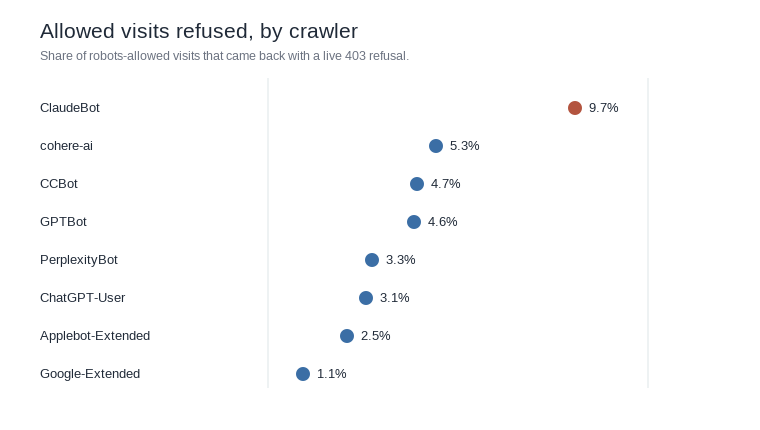
- ClaudeBot was refused most: 9.7% of its allowed visits (898 of 9,258).
A client's robots.txt is their stated policy: who may come in. It is a public file, easy to read, and most firms audit it and stop there. But the file is only the invitation. The server decides who actually gets through the door — and across our study, the server and the file disagree at a scale nobody's policy explains.
Our crawl recorded 74,105 matrix entries where a site's robots.txt allowed the crawler — the file said welcome. Of those allowed visits, 3,184 came back with a live 403 refusal (4.3%). Count every refusal status and 4,839 allowed visits (6.5%) were not served at all.
At site level it sharpens: 1,301 distinct sites — 14.3% of the 9,115 in the matrix population — refused at least one crawler their own file allows. Set that beside the sites that state a block in the file at all: 194. For every site that states a block in the file, several more refuse guests they formally invited, and almost none of them know.
It is not evenly spread
The refusals pick favorites. Of the visits each crawler was allowed, ClaudeBot was refused 9.7% of the time (898 of 9,258) — nearly one allowed visit in ten. Then cohere-ai at 5.3%, CCBot 4.7%, GPTBot 4.6%, PerplexityBot 3.3%, ChatGPT-User 3.1%, Applebot-Extended 2.5%, and Google-Extended just 1.1%. A client can be open to the whole list on paper and closed, in practice, to whichever crawler their infrastructure dislikes most.
The infrastructure is the tell. In the platform join, 21.6% of Cloudflare-fronted sites refused at least one allowed crawler — the highest of any major stack, ahead of nginx at 20.9% and LiteSpeed at 15.8%, with Apache lowest at 5.7%. The pattern points at bot-management tooling: the layer a host or CDN runs to keep bad traffic out does not distinguish a named AI crawler from a scraper unless somebody tells it to. Nobody told it to.
The check a client cannot run for themselves
Nothing here requires the client's intent to be bad, or even present. The file was written once — often carefully. The server configuration accreted later: a CDN switched on, a security rule tightened, a bot product enabled by a host. Each layer is reasonable. The sum is a business that believes it is open to AI and is, measurably, not.
That makes the refusal check the most valuable single diagnostic a firm can add to an audit, because the client cannot see it from where they sit. Reading robots.txt tells you the policy. Visiting as each crawler, and comparing what the server does against what the file says, tells you the truth. Where they differ, the fix is configuration — a rule adjusted, a crawler class allowed — not content, not a rebuild.
Your clients' doors are either open or they are not. The file is not the door. Check the door.
About this data: door-refusal analysis from our study's crawl — entries where the count is entries, sites where it is sites; the two are never merged. Stated-blocker count from the site-level certification of 2026-11-14.